> ## Documentation Index
> Fetch the complete documentation index at: https://docs.pawa-ai.com/llms.txt
> Use this file to discover all available pages before exploring further.
# Introduction
> An overview of agents in Pawa AI — autonomous, task-oriented systems that can reason, act, and interact with users and tools.
AI agents are autonomous systems that, given high-level instructions, can plan, use tools, carry out processing steps, and take actions to achieve specific goals, ranging from executing simple workflows to pursuing complex, open-ended objectives.
These agents leverage advanced natural language processing capabilities to understand and execute complex tasks efficiently and can even collaborate with each other to achieve more sophisticated outcomes.
Unlike a simple question-answer interaction, agents are designed to operate in more complex workflows, independently accomplish tasks on your behalf — where they can make decisions, call tools, and manage multi-step tasks.
> **Agents Example**
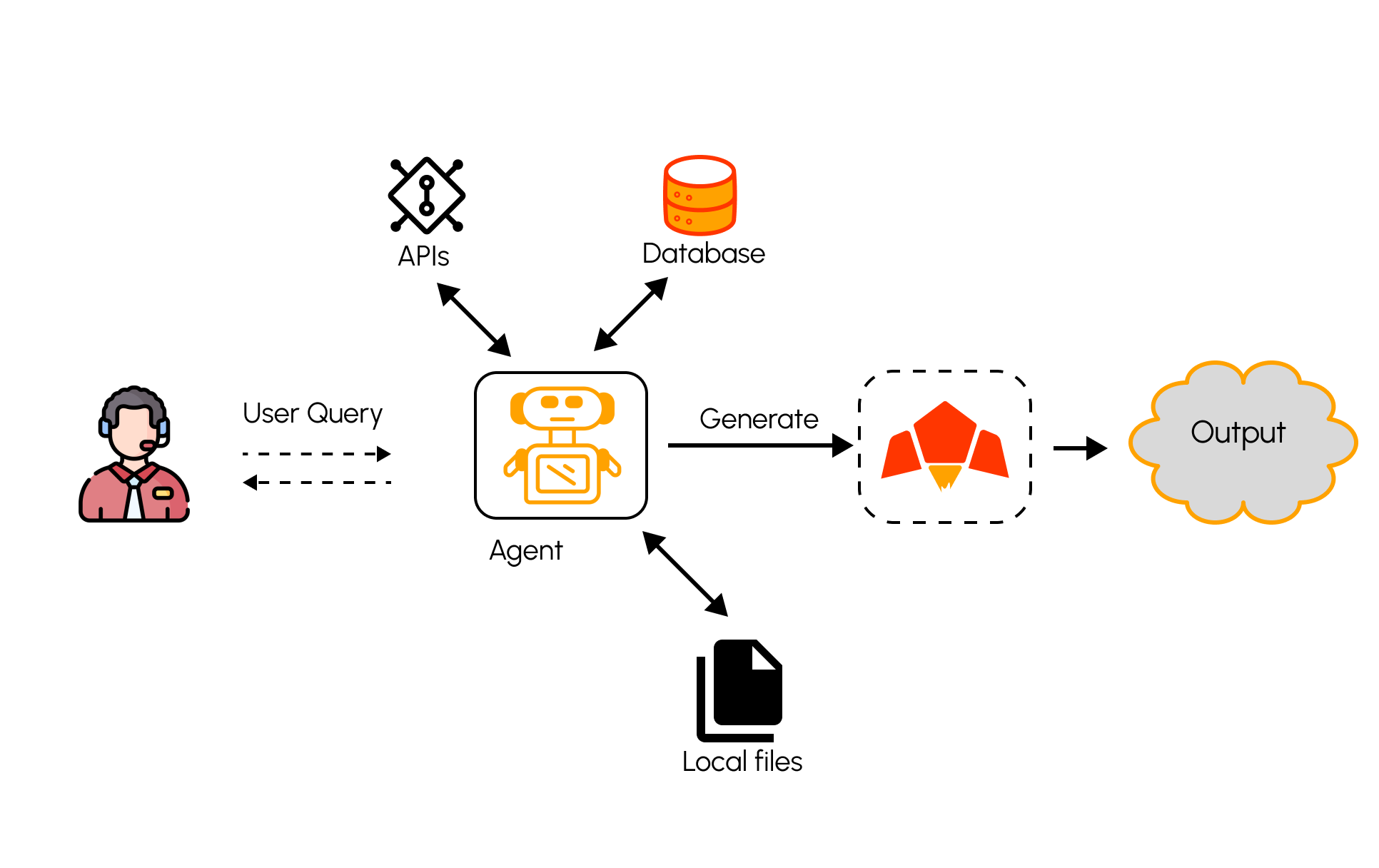 > An AI agent independently chooses the best actions it needs to perform to achieve those goals. For example, consider a contact center AI agent that wants to resolve customer queries. The agent will automatically ask the customer different questions, look up information in internal documents, and respond with a solution. Based on the customer responses, it determines if it can resolve the query itself or pass it on to a human.
> Multiple AI agents can collaborate to automate complex workflows and can also be used in agentic ai systems. They exchange data with each other, allowing the entire system to work together to achieve common goals. Individual AI agents can be specialized to perform specific subtasks with accuracy. An orchestrator agent coordinates the activities of different specialist agents to complete larger, more complex tasks
## Pawa AI Agentic Primitives
**Pawa AI** provides a rich set of composable primitives that enable you to build agents.
This guide walks through those primitives and how they come together to form a robust agentic platform.
> An AI agent independently chooses the best actions it needs to perform to achieve those goals. For example, consider a contact center AI agent that wants to resolve customer queries. The agent will automatically ask the customer different questions, look up information in internal documents, and respond with a solution. Based on the customer responses, it determines if it can resolve the query itself or pass it on to a human.
> Multiple AI agents can collaborate to automate complex workflows and can also be used in agentic ai systems. They exchange data with each other, allowing the entire system to work together to achieve common goals. Individual AI agents can be specialized to perform specific subtasks with accuracy. An orchestrator agent coordinates the activities of different specialist agents to complete larger, more complex tasks
## Pawa AI Agentic Primitives
**Pawa AI** provides a rich set of composable primitives that enable you to build agents.
This guide walks through those primitives and how they come together to form a robust agentic platform.
Foundation of intelligence — power your agents with state-of-the-art models.
Process text, images, and audio seamlessly for richer interactions.
Ground responses with your private or public knowledge sources.
Enable context persistence for more personalized and coherent conversations.
Generate outputs in JSON or other structured formats for direct integration.
Add speech-to-text and text-to-speech capabilities to your agents.
Guide agent behavior with system prompts, policies, and custom rules.
Extract, summarize, and reason over raw documents with precision.
Connect external APIs, plugins, and utilities for real-world actions.
Coordinate multiple agents, tools, and workflows for complex tasks.
## More Overview on Primitives
| Primitive | Purpose | Capabilities |
| ----------------------------------------- | -------------------------------------------------------------------------- | ------------------------------------------------------------------------------ |
| **Models** | The foundation of every agent, powering reasoning and language tasks. | Lightweight, large-scale, and specialized models (e.g., African languages). |
| **Multimodal Understanding & Processing** | Enables agents to work beyond text and handle multiple input/output forms. | Text, vision (images/docs), and speech (audio input & output). |
| **Knowledge Base (KB)** | Provides access to structured and unstructured data for reasoning. | Import documents/databases, query in natural language, combine KB with models. |
| **Memory** | Allows agents to retain information over time. | Short-term (conversation context) and long-term (user preferences/history). |
| **Structured Outputs** | Ensures machine-readable responses that follow strict schemas. | JSON schemas, reliable integration with APIs/databases/workflows. |
| **Voice** | Enables natural voice-based interaction with agents. | Speech-to-Text (STT), Text-to-Speech (TTS), streaming real-time conversations. |
| **Instructions** | Shapes agent behavior through role-setting and constraints. | Define roles, goals, tone, or language (e.g., “Always reply in Swahili”). |
| **Document Understanding** | Extracts and interprets data from documents. | Parse text, tables, metadata, summarize/translate, structured data extraction. |
| **Tool Usage** | Lets agents interact with external systems and APIs. | Call functions, APIs, search engines, or business tools dynamically. |
| **Orchestration** | Coordinates multiple primitives for complex workflows. | Multi-step reasoning, chaining tools/KB/memory, autonomous task handling. |
***
These **primitives are composable**, meaning you can mix and match them to design agents that:
* Understand multimodal inputs.
* Retain knowledge over time.
* Output reliable structured data.
* Use external tools.
* Orchestrate complex workflows.
## What Makes Agents Different?
* **Autonomous behavior**: Agents can decide the next best action instead of waiting for explicit instructions.
* **Goal oriented**: Agents can call APIs, databases, or external services to fetch or manipulate information.
* **Reasoning**: Agents break down complex tasks into steps, enabling better problem-solving.
* **Collaboration**: Agents break down complex tasks into steps, enabling better problem-solving.
***
## Example Use Cases
* **Customer Support Agent**: Answers questions, checks knowledge bases, and integrates with CRM systems.
* **Data Analysis Agent**: Queries databases, runs calculations, and summarizes insights.
* **Educational Agent**: Tutors students, generates quizzes, and adapts learning paths.
* **Research Agent**: Reads documents, extracts entities, and generates structured summaries.
***
Agents mark a new era in workflow automation, where systems can reason through ambiguity, take
action across tools, and handle multi-step tasks with a high degree of autonomy. Unlike simpler
language models applications, agents execute workflows end-to-end, making them well-suited for use cases
that involve complex decisions, unstructured data, or brittle rule-based systems.
To build reliable agents, start with strong foundations: pair capable models with well-defined tools
and clear, structured instructions. Use orchestration patterns that match your complexity level,
starting with a single agent and evolving to multi-agent systems only when needed. Guardrails are
critical at every stage, from input filtering and tool use to human-in-the-loop intervention, helping
ensure agents operate safely and predictably in production.
The path to successful deployment isn’t all-or-nothing. Start small, validate with real users, and
grow capabilities over time. With the right foundations and an iterative approach, agents can
deliver real business value—automating not just tasks, but entire workflows with intelligence
and adaptability.
If you’re exploring agents for your organization or preparing for your first deployment, feel free
to reach out. Our team can provide the expertise, guidance, and hands-on support to ensure
your success.